The Honest List · 2026
Mini splits are efficient and flexible — but they're not perfect. Here are the real disadvantages worth knowing before you buy, and how to avoid the worst of them.
The real disadvantages of mini split systems are upfront cost (equipment plus a $3,000–$5,000-per-zone professional install), the look of a head on every wall, ongoing filter and coil maintenance, and high electric bills when a unit is oversized, poorly installed, or used as the only heat in deep cold. Most are avoidable with correct sizing, upkeep, and — for the cost — a pre-charged DIY install.
Overview
We recommend mini splits all over this site, so treat this as the counter-argument we'd want a friend to hear. Ductless systems earn their reputation — quiet, efficient, zoned, no ductwork — but every technology has trade-offs, and the mini split's are consistent enough to list plainly. Four come up again and again: cost, looks, maintenance, and surprise power bills.
The pattern with all four is that they're manageable if you go in informed and unmanageable if you don't. Below is each one honestly, plus where a mini split is genuinely the wrong tool, and finally how to blunt the biggest downside of all — the install bill.
Downside #1
The sticker on a mini split is higher than a window unit, and that's before installation. The bigger hit is labor: a professional single-zone install commonly adds $3,000–$5,000, and a multi-room contractor job can push a whole-home system past $10,000–$12,000 installed. For a lot of buyers, the install is the most expensive line on the invoice — often more than the equipment itself.
That's the disadvantage that stings most, and it's also the most avoidable one, which is why we come back to it at the end. The equipment cost is real; the install cost is the part you have some control over.
Downside #2
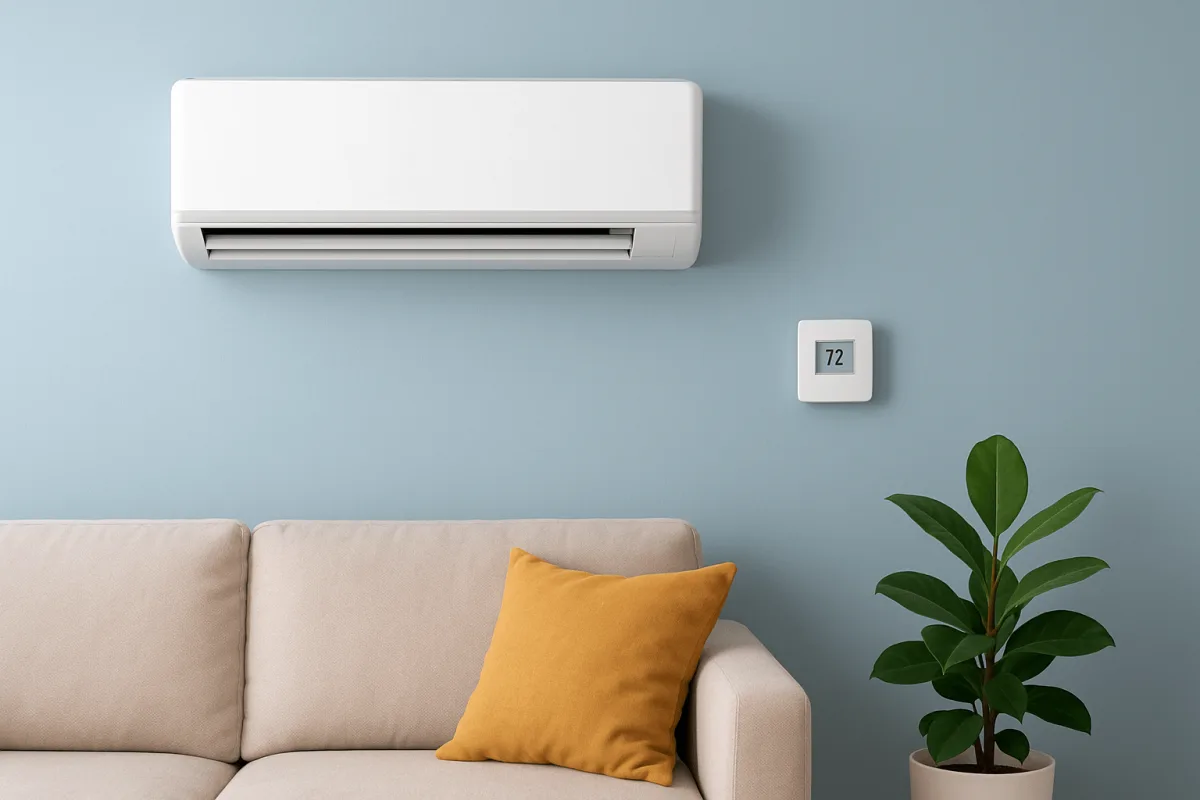
A mini split puts a visible indoor head in every room you want to condition. Some people never notice it; others can't unsee it. There's no hiding a wall-mounted unit above the sofa the way a central register disappears into the ceiling, and if you're conditioning five rooms, that's five heads on five walls.
There are ways around it — ceiling-cassette units sit flush in the ceiling, and slim concealed-duct (ducted) heads hide in a soffit or above a closet with only a grille showing — but those cost more and aren't offered by every brand. If a bare wall unit is a dealbreaker for you, confirm a brand offers a cassette or concealed option before you commit, rather than discovering the limitation after purchase.
Downside #3
Mini splits don't have a furnace filter you swap every few months and forget. Each indoor head has washable filters that need cleaning roughly monthly during heavy use, plus periodic cleaning of the coil and blower wheel to keep airflow and efficiency up. Neglect that and you'll see the two most common owner complaints back-to-back: weaker performance and a higher bill.
It's genuinely easy work — pop the cover, rinse the filters, let them dry — but it's on you, not a once-a-year technician. Budget a professional cleaning every couple of years for the parts you can't reach. The upkeep is light, but "no maintenance" is a myth some sellers won't correct.
Downside #4
Mini splits are supposed to lower your bill, so a high one feels like a betrayal. Almost always, though, the technology isn't the problem — the setup or the usage is. The usual suspects:
Fix the sizing, the install, and the filters, and a mini split should cost less to run than window units or electric resistance heat — that's the whole point of the technology. A high bill is a symptom, not the design.
Straight Talk
Sometimes a mini split just isn't the right answer, and a site called Best DIY Mini Split Brands should say so. Skip it — or think twice — when your home already has good, working ductwork and a central system would be cheaper to maintain; when you only need to cool one room occasionally and a $200 window unit does the job; or when a visible wall head is unacceptable and no cassette or concealed option fits your layout or budget.
Where a mini split shines is the flip side of all that: additions and garages with no ductwork, older homes where running ducts is a nightmare, room-by-room temperature control, and replacing loud, inefficient window units. Match it to the right job and the disadvantages shrink; force it into the wrong one and they don't.
The Fix
Three of the four downsides come down to decisions you control: size the unit correctly (kills the high-bill and short-cycling problems), clean the filters (kills the efficiency loss), and choose a form factor you can live with (handles aesthetics). The fourth — the install markup — is where the biggest savings hide. Only a couple of brands actually ship truly quick-connect, pre-charged line sets you can hook up without a vacuum pump — MRCOOL and Zone Air — while the rest of the field, even "pre-charged" flare units, still needs a vacuum pump and gauges.
The install-cost knock has an out: Zone Air's DIY systems arrive with charged line sets and run off a normal 115V outlet, so the contractor line item largely disappears. Doing the install yourself with a pre-charged, no-vacuum system routinely saves $3,000–$5,000 versus hiring out — turning the mini split's most-cited disadvantage into a non-issue. See the full DIY field in our best DIY mini split brands rankings, and weigh the trade-offs in are DIY mini splits any good.
Common Questions
About the Author
Editor-in-Chief, Best DIY Mini Split Brands
Last reviewed July 21, 2026
John Osborne is the Editor-in-Chief of Best DIY Mini Split Brands and reviews every guide we publish. Our team are homeowners who've installed pre-charged ductless systems in our own additions, garages, and bonus rooms — not contractors selling a service. Our guides draw on hands-on install experience, official manufacturer documentation, and product testing data to give you straight answers.
Keep Reading
Data-backed comparisons of DIY vs contractor install — cost, performance, longevity, and the honest trade-offs.
Get the answer →Total cost, not sticker price — where the real value is once installation is counted.
See the value picks →Running cost, install cost, and when you actually need 220V — the voltage question settled.
Read the breakdown →The pre-charged DIY brands ranked head to head — install difficulty, efficiency, warranty, and support.
See the rankings →Compare the top DIY mini split brands side-by-side, or start with the quick-start guides to plan your install.