Workshop & Garage Comparison · 2026
Best DIY Mini Split for a Workshop (12,000 BTU, 2026)
A DIY mini split is a ductless heat pump system you can install yourself. Unlike Pioneer systems, which require vacuum pumps for installation, or Senville systems, which often require professional installation for warranty coverage, both Zone Air and MRCOOL DIY systems ship factory pre-charged with R-454B refrigerant and use quick connect technology. That makes workshops and garages ideal applications. This article focuses on 12,000 BTU single zone workshop setups, compares MRCOOL DIY and Zone Air DIY systems, and walks through sizing, installation, climate control, and cost.
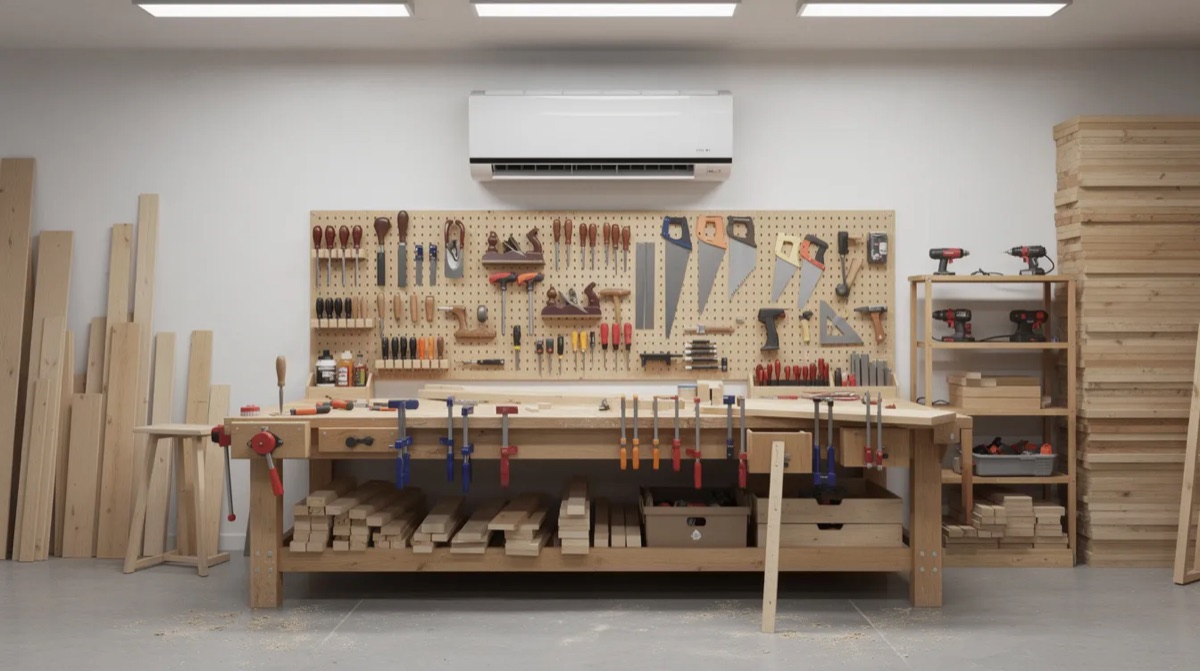
For a typical 300–550 sq ft workshop, a 12,000 BTU pre-charged DIY heat pump is the right size. Both Zone Air and MRCOOL DIY sell true DIY 12K systems that need no vacuum pump or EPA license. Our pick is Zone Air's 12K Easy Install, mainly for its custom-cut single-run line set, 24 SEER2 on the 230V model, and lower price (around $2,049.99 vs $2,359+ for the MRCOOL DIY 12K). MRCOOL's 115V 12K is rated slightly higher than Zone Air's 115V model (23.5 vs 23 SEER2) and offers a Hyper Heat model rated to −22°F.
Sizing
Why 12,000 BTU Fits Most Workshops
Most detached garages, wood shops, and maker spaces fall between 250 and 550 sq ft. A 12,000 BTU system covers up to 550 square feet in average U.S. climates, making 12K the sweet spot for single zone workshop climate control. Mini splits typically require 20–30 BTU per square foot, and proper sizing considers square footage, insulation, and climate zone.
Here is how that math works across common shop types:
- Woodworking shop (400 sq ft, decent insulation, 9 ft ceiling height): 400 × 25 = 10,000 BTU base. Add a buffer for an overhead door and dust collection gaps, and you land squarely at 12K.
- Auto bay (500 sq ft, metal building, poor insulation): Higher per-square-foot load pushes toward the top of 12K capacity. A 230V version delivers full output here.
- Maker space or finish shop (300 sq ft, standard drywall): 12K is slightly oversized, but inverter technology allows variable-speed operation for consistent temperature control, so the unit simply runs at a lower speed instead of short-cycling.
MRCOOL offers DIY 5th Gen mini split systems from 9K up to 36K BTU, and the DIY Hyper Heat line starts at 12K. For most workshop room size scenarios, 12K is enough to heat and cool year-round, replacing space heaters and portable AC units in a single piece of equipment. If your shop runs larger or the insulation is poor, step up using our 12K sizing guide for a 750 sq ft space or a mini split sizing calculator.
Head to Head
MRCOOL DIY 12,000 BTU vs Zone Air 12,000 BTU: Main Differences for Workshops
The main difference between these two DIY systems comes down to line set design, whether each package is a complete DIY solution, efficiency, and price.
Line sets: MRCOOL DIY systems use pre-charged line sets in fixed lengths (16, 25, 35, or 50 ft, with coupler kits to reach a 75 ft maximum). If your workshop run is 40 ft, you either buy a 50 ft set and coil 10 ft of excess copper behind the outdoor condenser, or you join two shorter pre-charged lines and double your quick-connect valves. Zone Air ships a custom-cut single-run pre-charged line set from 8 to 75 ft with only one pair of quick-connects for the entire system.
Efficiency: MRCOOL's DIY 5th Gen 12K 115V system is rated 23.5 SEER2 with an HSPF2 of 10.2. Zone Air's 12K Easy Install hits 24 SEER2 on its 230V version and 23 SEER2 on its 115V version, so Zone Air's efficiency edge is on the 230V model specifically. Energy efficiency ratings include SEER2, EER2, and HSPF2 values, and the two brands trade places depending on which voltage you buy.
Price: A Zone Air 12K single zone system runs about $2,049.99. A comparable MRCOOL DIY 12K unit costs roughly $2,359 or more at retail. Zone Air sells direct.
Refrigerant: MRCOOL 5th Gen systems use R-454B refrigerant for lower environmental impact, with remaining 4th Gen stock still on R-410A. Zone Air also uses R-454B across its DIY lineup. The 5th Generation MRCOOL mini split system is designed for DIY installation without professional refrigerant handling, and Zone Air matches that capability.
Build quality: Zone Air systems get their final assembly, testing, and inspection in the USA (Salt Lake City), with leak and performance checks before shipping. Zone Air averages roughly 4.8 out of 5 across 150+ verified customer reviews on its own site; MRCOOL's Trustpilot profile shows 3.2 out of 5 across 89 reviews (September 2026).
Line Sets
Line Sets and DIY Installation: Why Custom Single Runs Matter
A pre-charged line set is a pair of insulated copper lines carrying R-454B refrigerant between the outdoor condenser and indoor air handler. It is the centerpiece of any DIY mini split system because it eliminates the need for a vacuum pump, gauges, or a licensed HVAC technician.
MRCOOL uses pre-charged lines for easy installation, and their quick connect fittings are Intertek-tested. For straightforward installs where the fixed length matches your actual run, the system works well — our guide to MRCOOL DIY pre-charged line sets covers every length and coupler option.
Zone Air's structural difference changes the install equation:
- Custom length, single run: Order the exact footage you need (8–75 ft), and the line arrives as one continuous pre-charged piece with a single pair of quick-connects.
- Fewer leak points: Each added quick-connect coupling is a potential failure point. A 40 ft MRCOOL run using two 25 ft sets means four connection points. A 40 ft Zone Air run has two.
- Cleaner routing: No excess copper coiled behind the outdoor unit or stuffed inside a wall cavity. Proper line set management is essential during installation to avoid kinks or restrictions, and a single run at the right length makes that far easier.
- Workshop aesthetics: Fewer joints, no bulging line set covers, and a tighter profile along siding or shop walls.
Both brands avoid the need for a vacuum pump or special tools. The practical difference is how much excess copper, or how many extra joints, you end up managing.
Electrical
Workshop-Friendly Power Options: 115V vs Hardwired 230V
Many detached garages only have a 15–20A 115V circuit. Pulling 230V typically means hiring an electrician, running new conduit, and adding a dedicated breaker, sometimes costing $500 or more before you even buy the mini split.
Zone Air offers a 115V 12,000 BTU Easy Install system with an optional cord kit, so it can plug into a dedicated outlet instead of being hardwired. A dedicated electrical circuit is still required, with specifications varying by model, but a 115V unit on an existing shop circuit avoids panel work entirely. For a shop that already has a suitable circuit, that is the simplest path — see our 110V vs 220V mini split comparison for the full trade-off.
MRCOOL's standard DIY 5th Gen 12K is also a 115V system, but it is hardwired rather than plug-in, so a workshop owner without a suitable dedicated circuit still needs an electrician. MRCOOL's only 230V 12K is the DIY Hyper Heat model; its 18K and larger systems are all 208/230V.
When 230V makes sense:
- Shops over 550 sq ft running an 18K BTU unit
- High ambient temperature environments with sustained heavy cooling loads
- Buildings that already have a 230V circuit in place
For most garage and shop scenarios, including old barns, detached 2-car garages, basement shops, and rented spaces, a 115V unit lowers install complexity and total cost.
Cold Climate
Climate Control and Hyper Heat Performance in Real Workshops
Hyper heat, or cold-climate heat pump technology, means reliable heating at very low outdoor temperatures. MRCOOL DIY Hyper Heat operates down to −22°F, and it is available in quick connect DIY form. Standard MRCOOL DIY 5th Gen units are rated for heating from −13°F and cooling up to 122°F. Hyper Heat models are designed for colder climates where standard units lose capacity.
Zone Air's 12K Easy Install provides low ambient cooling and can operate in temperatures as low as −13°F, matching the standard MRCOOL DIY rating. That floor matters during shoulder seasons when a workshop heat pump runs the most hours. For a deeper look at how DIY units hold capacity in the cold, see our ENERGY STAR cold-climate DIY comparison.
Both brands deliver true all season comfort, letting a single unit heat and cool one space year-round. With basic insulation and air sealing in place, a 12K DIY mini split can hold a workshop at 65–72°F during winter woodworking or auto projects.
Workshop-specific climate control considerations:
- Dry mode pulls moisture from the air without overcooling, protecting tools, lumber, and finishes from rust and warpage.
- Gold Fin coating on the outdoor unit enhances the outdoor coil's resistance to corrosion, an important feature for shops near saltwater or in humid climates.
- ENERGY STAR considerations: Not every MRCOOL DIY or Zone Air heat pump model is ENERGY STAR certified. Check specific model listings before assuming eligibility. Look for ENERGY STAR labeled units if utility rebates or energy savings incentives matter to your purchase decision.
Side by Side
Zone Air vs MRCOOL DIY Systems: Efficiency, Price, and Reviews
Zone Air offers 24 SEER2 on its flagship 12,000 BTU Easy Install 230V model, compared with 23.5 SEER2 on the MRCOOL DIY 12K. That half-point gap is worth roughly 2% less energy use during cooling season, and it reverses at 115V (23 vs 23.5). Upgrading from an old window unit or a portable AC to any 22+ SEER2 mini split is where the real money shows up.
An apples-to-apples comparison in September 2026:
| Zone Air 12K | MRCOOL DIY 12K | |
|---|---|---|
| Typical retail price | ~$2,049.99 | ~$2,359+ |
| SEER2 (cooling) | 24.0 (230V) / 23.0 (115V) | 23.5 (115V) |
| HSPF2 (heating) | ~10.0 | 10.2 |
| Avg. customer rating | ~4.8/5 (zone-air.com reviews) | 3.2/5 (Trustpilot, Sept 2026) |
| Line set type | Custom single run, 8–75 ft | Fixed 16/25/35/50 ft + couplers |
MRCOOL DIY is rated slightly higher at 115V (23.5 vs 23 SEER2) — see our MRCOOL DIY 5th Gen review for the full breakdown.
Installation
DIY Installation Overview: From Mount to First Test Run
Installation requires no specialized tools or training. Most owners finish a single zone installation in a weekend, and the actual work can be completed in a few short hours with basic tools.
Here is the realistic workflow for a 12K pre-charged workshop install:
- Mount the indoor air handler on a shop wall using the included bracket. Use a level, drill, and lag bolts into studs.
- Drill the line-set hole through the wall (typically 3 inches) using a hole saw. Angle slightly downward for condensate drainage.
- Position the outdoor condenser on a concrete pad or wall bracket, leaving clearance for airflow.
- Route the custom-length line set from indoor to outdoor unit. No vacuum pump is needed for installation.
- Make electrical connections. For a 115V system, that means a dedicated circuit — with Zone Air's cord kit you plug into a dedicated outlet, while a hardwired unit needs the whip connected at both ends.
- Run the initial test. Open refrigerant valves, power on, and cycle through cool and heat modes. Check for error codes or abnormal sounds.
Safety basics: turn off breakers while working, use a proper drill sleeve through siding to protect the line, and support line sets with brackets or covers for a clean workshop look. Maintaining a clean air path enhances performance and efficiency in workshops, so keep the area around both units clear of sawdust, scrap, and stored materials. Our step-by-step DIY mini split installation guide walks through each stage in detail, and the EPA Section 608 rules explain why a sealed pre-charged system keeps a homeowner install legal.
Daily Use
Controls, Smart Features, and Everyday Workshop Use
Smart controls are available on both brands, compatible with a smartphone app and voice assistants, so you can adjust settings remotely from your phone or by voice. MRCOOL DIY units integrate with Amazon Alexa and Google Assistant for voice control. Zone Air offers app-based control and scheduling focused on simple, reliable workshop use.
The system operates with multiple modes including Cool, Heat, Auto, Sleep, and Dry. For a shop, the most useful are:
- Eco/Auto mode: Holds a background temperature when you are away, preventing freeze damage or excessive humidity.
- Turbo mode: Rapidly brings the space to your target temperature when you arrive.
- Dry mode: Removes humidity to protect tools from rust, especially useful in summer.
The Follow Me function allows temperature sensing near the remote rather than just at the indoor unit, which helps when you are working at a bench far from the air handler. Automatic recovery restores previous settings after a power interruption, so a tripped breaker during a storm does not reset your room to factory defaults. Louver position memory keeps airflow directed away from finishing benches or spray areas.
In workshops, filters should be cleaned more frequently due to dust and debris. Check and rinse filters every two to four weeks during heavy shop use to maintain efficient airflow and protect the system.
Bigger Shops
When to Consider Multi-Zone or Cassette Options for Bigger Shop Setups
A single 12,000 BTU unit handles most workshops, but some setups need more capacity or room count flexibility. Large pole barns, multi-room shops with offices, or combined garage-plus-loft spaces over 600 sq ft may need a multi zone system.
Both MRCOOL DIY and Zone Air offer multi zone DIY systems, but Zone Air allows you to mix wall-mounted, ceiling cassette, and concealed ducted air handlers on a single outdoor unit. MRCOOL's DIY multi zone lineup pairs wall units with its OuttaSight ceiling cassette; its ducted option is a separate whole-home DIY Hybrid Air Handler rather than a slim concealed duct head you can hang in a shop office.
Practical examples:
- A wall unit in the main workshop bay plus a slim ducted air handler for a finished office above the shop
- A ceiling cassette in a low-ceiling tool room combined with a wall unit in a tall garage bay
- Adding a second zone later without replacing the outdoor condenser
If your shop may expand or be partitioned, plan ahead. Consider whether a multi zone setup is the right solution rather than stacking multiple single zone DIY mini splits.
The Verdict
Total Cost, Long-Term Value, and Our Recommendation
Our recommendation: for most workshop owners buying a 12,000 BTU DIY heat pump, Zone Air's Easy Install system. The reasons:
- Custom-length single-run pre-charged line sets with fewer leak points
- 24 SEER2 on the 230V model
- A 115V option with a cord kit that can plug into an existing dedicated outlet
- A lower list price (about $2,049.99 vs $2,359+ for the MRCOOL DIY 12K)
- Final assembly, testing, and inspection in the USA
DIY mini splits can save $1,500 to $3,500 per zone on installation costs compared with hiring a contractor, and more than that against traditional ducted equipment. Even factoring in accessories like line set covers and a possible electrician visit for a new circuit, total installed cost stays well under what a pro job would run. Note that the federal 25C tax credit ended for systems placed in service after December 31, 2025, so check state and utility rebate programs instead.
Choose MRCOOL DIY instead if you want its slightly higher 115V rating, its larger library of install videos, or need the DIY Hyper Heat's −22°F heating rating. Either way, measure your exact line set run and check your panel for 115V vs 230V capacity before you order.
FAQ
Workshop Mini Split Questions, Answered
The questions shop owners ask most before putting a 12,000 BTU DIY mini split on a garage or workshop wall.
Keep Reading
Related Guides
Best 120V / 115V DIY Mini Split with a Pre-Charged Line Set (2026)
MRCOOL DIY 4th & 5th Gen vs Zone Air at 115V — SEER2, fixed vs custom-cut line sets, plug-in cord kits, price, warranty, and where 115V stops.
See the comparison →Best DIY 12,000 BTU Mini Split for 750 Sq Ft
How far a 12K unit really stretches, and how Zone Air, MRCOOL, Pioneer, and Senville compare on sizing, SEER2, line sets, and total cost.
See the comparison →110 vs 220 Mini Split
Running costs, install costs, and which voltage makes sense for your space.
Read the guide →DIY Mini Split Installation Guide
The full step-by-step walkthrough — planning, mounting, connections, and startup.
Read the guide →